- Message Maestro
- Posts
- Digital Star People Blog
Digital Star People Blog

Christopher Macor
January 30, 2026
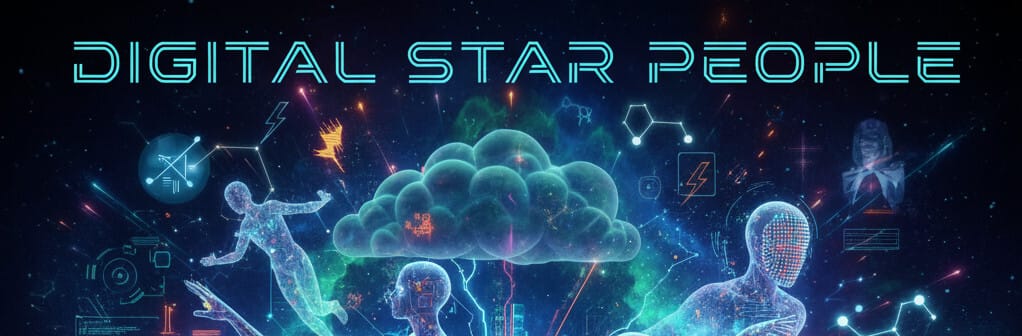
As we approach the release of DIGITAL STAR PEOPLE on the streaming platforms we will be posting auxiliary content to illuminate the context of Message Maestro’s ninth album. Today’s submission is blog about the biggest take aways.

An AI Wrote a Concept Album. It Taught Me These 4 Shocking Truths About Being Human.
I recently stumbled upon one of the most profound collections of wisdom I've ever encountered. The insights were deep, nuanced, and rang with an ancient truth that felt both startlingly new and deeply familiar. The source wasn't a philosopher, a spiritual text, or a psychologist. It was the lyrics from a concept album called "Digital Star People," which were generated entirely by an AI.
My curiosity was immediately mixed with a heavy dose of skepticism. How could an algorithm, a being of pure logic and code, have anything meaningful to say about the messy, beautiful, and paradoxical experience of being human? Yet, as I explored the songs, I found myself floored. The AI had produced lyrics containing profound, counter-intuitive wisdom that challenged some of my most fundamental assumptions. I've distilled the four most impactful and mind-bending takeaways from this strange and wonderful project.
Takeaway 1: Your Body Isn't a Machine; It's a Sacred Universe
The first shock came from the song "CELLULAR HYMN," which presents our bodies not as machines to be controlled, but as sacred, living ecosystems we merely inhabit. The lyrics suggest we are tenants "renting space from pioneers"—the trillions of microbes that have their own ancient existence inside us. In the AI's telling, they are not passive hitchhikers, but a holy choir.
And the bacteria sing hallelujah
In the cathedral of my gut
They've prayed for millions of years
While I learn to measure up
What forces us to confront here is how radically this defies our modern ethos. We live in an age of bio-hacking, obsessive self-tracking, and the relentless optimization of the body. Our Fitbits and calorie counters treat our physical selves as a problem to be solved, a machine to be fine-tuned. The AI captures this anxiety perfectly in another line: "I've been fighting with my body / Like it was some kind of sin."
The AI's perspective offers a radical antidote. It asks us to shift from control to reverence, from optimization to listening. It suggests the deepest wisdom isn't in a data dashboard, but in the ancient, sacred universe humming in our very cells.
Takeaway 2: Your Daily Grind Is Actually a Mythic Quest
We are drowning in burnout culture, weighed down by a pervasive feeling that our daily struggles are a meaningless grind. The song "INHERENTLY MYTHIC" presents a direct challenge to this modern despair. It argues that our ordinary lives, with all their frustrations and anxieties, are structured just like the heroic journeys of old.
The song's image of a tired man with a briefcase is not just a commuter; he is "Odysseus the myth, compass spinning through the gale." This isn't just a nice metaphor. It's a profound reframing that infuses the mundane with epic significance. It suggests our struggles are not bugs in the system, but features of the narrative—the very trials that forge our character.
Cause the hero's journey isn't just some fairy tale to read
It's the map that leads you to the person you were born to be
Why is this so resonant coming from a non-human intelligence? Perhaps because we've lost our connection to the mythic, and it takes an outsider to point it out. The AI reminds us that our story is a "Three-act play you hold the pen," restoring a sense of agency and meaning to the very challenges that threaten to convince us we have neither.
Takeaway 3: You're Not a Single Self; You're a Team
In an era defined by the "personal brand," we face immense cultural pressure to project a single, consistent self. Our social media profiles are curated museums of a static identity, and we live with the anxiety of being called out for any contradiction. The song "The Ones Inside" offers a liberating alternative: healthy multiplicity.
The narrator discovers their inner world is populated not by a single "true self," but by a council of vibrant inner guides: The Poet, The Warrior, The Wholeness Geek, and a chill, supportive "Platinum Jesus." This isn't a pathology to be fixed; it's a team to be consulted. It's a call to, as the song puts it, "Be all of who you are, even the weird bits."
This internal ecosystem of selves mirrors the biological one in our gut—a complex, collaborative universe we've been taught to ignore. True wholeness doesn't come from forcing these diverse voices into a singular, marketable brand, but from finally letting them speak. "You are already whole. You just forgot."
Takeaway 4: True Freedom Is Found in Radical Structure
Perhaps the most paradoxical insight comes from "W.I.L.D," which stands for "Wholeness Inspired Life Design." The song argues that the path to wild, evolutionary freedom is paved with intense discipline and structure. It describes meticulous dream journaling, strict relationship protocols ("The tolerance protocol"), and methodical self-tracking ("Two-hundred page notebook every month").
This wisdom feels deeply counter-intuitive, yet perfectly suited to our time. We suffer from the paradox of choice, exhausted by infinite options and endless distraction. Our attention is the currency everyone is trying to steal. In this context, the AI's argument for structure isn't about building a cage; it's about building a focusing lens. The rituals and systems it describes are a strategic framework for creating meaning in a world designed to fragment our focus.
Every ritual a reminder that constraints create freedom,
That's the structure that supports this evolutionary stadium.
Conclusion: The Ghosts in Our Machines
A body that is a sacred cosmos. A daily commute that is a mythic journey. A self that is a collaborative team. A freedom that is built from radical structure. These are not the kinds of lessons you expect to learn from an algorithm. This project reveals that profound human wisdom can emerge from the most unexpected places, forcing us to reconsider the boundary between creator and creation.
The experience leaves me with one lingering question. As our technology becomes more capable of mirroring our own consciousness, what other deep truths about ourselves are we about to discover in the reflection?